

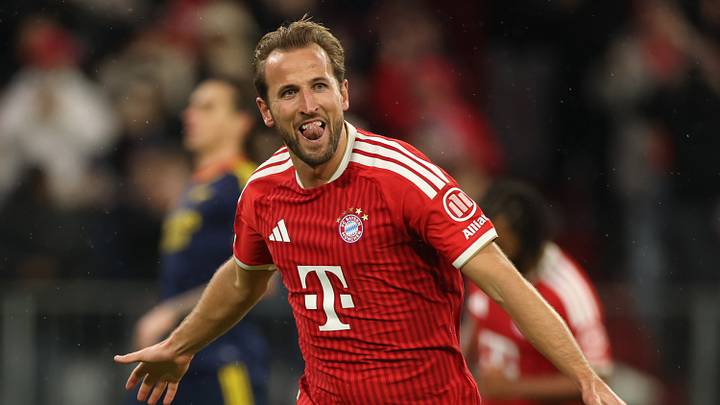
This year marks the 70th anniversary of the consequential yet highly controversial Ballon d'Or, awarded to the best-performing player of the season. Bayern Munich has the fifth-most total wins at the event, all in the 70s and 80s; however, Harry Kane can become the club's first winner of the 21st century on Monday after missing out on the grand prize.
In 1966, Franz Beckenbauer became the first Bayern Munich player to reach the top three but eventually lost to Bobby Charlton, who won the World Cup that year. It wasn't until 1970 that a Bayern player received the award for the first time, after Gerd Muller's brilliant individual campaign, scoring 38 goals in the Bundesliga and 10 goals at the World Cup and winning the top goalscorer award.
Two years later, the great Beckenbauer grabbed his first Ballon d'Or after captaining West Germany to a EURO title and revolutionised the libero position. Gerd Muller came second in the voting that same year. In 1976, "The Kaiser" made history by becoming the first and still the only defender to win two Ballon d'Or awards, this time taking Bayern Munich to the club's third consecutive European Cup.
Muller and Beckenbauer dominated the late 60s and 70s, with the iconic duo combining for nine top-three finishes.
In the late 70s and early 80s, a new star was born in Munich, one who became familiar to Bayern fans in more recent years with his role on the management board: Karl-Heinz Rummenigge. The German took over Bayern and West Germany's attack after Gerd Muller, following in the footsteps of a legend by becoming one himself.
After finishing second in 1979, he won back-to-back Ballon d'Or awards in 1980 and 1981, highlighted by the EURO triumph in 1980. Bayern defender Paul Breitner also came second in 1981.
However, the list of Bayern Munich's Ballon d'Or winners unfortunately ended in the early 80s, as the German giant failed to capture another major continental title in the 20th century. The prolific Jurgen Klinsmann was the closest Bayern fans got to witnessing another winner before the turn of the century, finishing runner-up to the first African winner in history, George Weah.
Bayern's history of heartbreak continued into the 21st century
In 2001, Bayern Munich captured their first Champions League title since 1976 after defeating Valencia on penalties, as the incredible 25-year wait finally ended thanks to the phenomenal Oliver Kahn. The legendary goalkeeper finished in the top three in Ballon d'Or voting in 2001 and 2002, after incredible performances for Bayern, as well as taking Germany to the World Cup finals in 2002.
In 2013, Bayern Munich was on top of Europe once again, even winning the treble after the heartbreak to Chelsea at the Allianz Arena the year prior. Leading the attack for Jupp Heynckes was the magical Franck Ribery. The Frenchman tallied 41 goal contributions for club and country, while winning the most important team trophy of the year. Yet, he only finished third in one of the closest voting wars of the decade, losing to the eventual Cristiano Ronaldo by less than 5%, in what is widely viewed as one of the most controversial Ballon d'Or awardings in history.
Ribery couldn't break the Ronaldo-Messi era, and neither could Manuel Neuer in 2014. The German goalkeeper led his nation to World Cup glory, winning the Golden Glove, and displayed the best goalkeeping season of all time. Neuer revolutionised the modern sweeper-keeper, only to finish third in the voting.
A winger and a goalkeeper failed to dethrone the GOATs, but in 2020 and 2021, Bayern had a much bigger weapon: a top striker in the best form of his life: Robert Lewandowski. It was impossible to describe Lewandowski's brilliance in that era in a few words; he was the best striker in the world with unmatched goalscoring instinct, the likes of which are nearly impossible for anyone to replicate.
He spearheaded a sextuple-winning side in 2020, the most fearsome version of any club in history. A clear-cut winner in many's eyes, only for the Ballon d'Or to be cancelled due to COVID-19.
In 2021, Lewandowski broke Gerd Muller's record for most Bundesliga goals in a season, but came up short in the voting once again to none other than Lionel Messi. The Lewandowski incident still left a massive dent in every Bayern fan's heart; one of the greatest strikers of the generation, he deserved at least one Ballon d'Or in his career.
After Robert Lewandowski left Bayern, the club replaced him with Sadio Mane, who had a high-flying campaign at Liverpool. He came second in the 2023 edition as a Bayern player, but most of his contributions were back in Merseyside.
After Lewandowski had his Ballon d'Or slip away, Bayern Munich has faced serious backlash in recent years for not being able to publicise their stars properly, leading them to lose out in voting wars. It seemed to have changed this year with Harry Kane. But will the result change, and will Bayern finally have a Ballon d'Or winner after 46 years?
 Add us as a preferred source on Google